Best Lakefront Hotels Membership Plans: A Forensic Audit
The contemporary landscape of high-end, water-adjacent hospitality operates on a fundamental tension: the scarcity of prime shoreline real estate versus the increasing demand for immersive, multi-seasonal recreational access. For the frequent traveler, the resolution to this tension often manifests as an invitation into exclusive membership ecosystems. These programs are rarely simple loyalty schemes; they are, in practice, financial instruments designed to manage guest throughput, secure capital for infrastructure maintenance, and hedge against the volatility inherent in resort operations. To navigate this space effectively, one must treat the membership contract not as a promise of luxury, but as a complex administrative asset with specific liquidity, utility, and liability profiles.
When evaluating the best lakefront hotels membership plans, the central challenge involves decoupling the emotional appeal of the setting—the view, the silence, the proximity to the water—from the structural realities of the resort’s governance. A membership that provides access to a legacy property with failing mechanical infrastructure is, regardless of the brand prestige, a high-risk financial commitment. Conversely, a less-celebrated resort that utilizes institutional-grade management and rigorous site-maintenance protocols may offer superior long-term utility. Understanding the value of these plans necessitates a move away from passive consumption toward a forensic, audit-style methodology, wherein the member scrutinizes the resort’s operational culture as deeply as they do the room rate.
Ultimately, the goal of this investigation is to provide a comprehensive framework for the professional evaluation of riparian hospitality memberships. We examine the evolution of these programs, the conceptual models used to assess their internal value, and the systemic risks that arise when hospitality governance fails to keep pace with environmental constraints. By shifting the perspective from visitor to participant-auditor, one gains the clarity required to identify which arrangements offer sustainable, high-performance utility in an environment defined by constant physical change.
Understanding best lakefront hotels membership plans
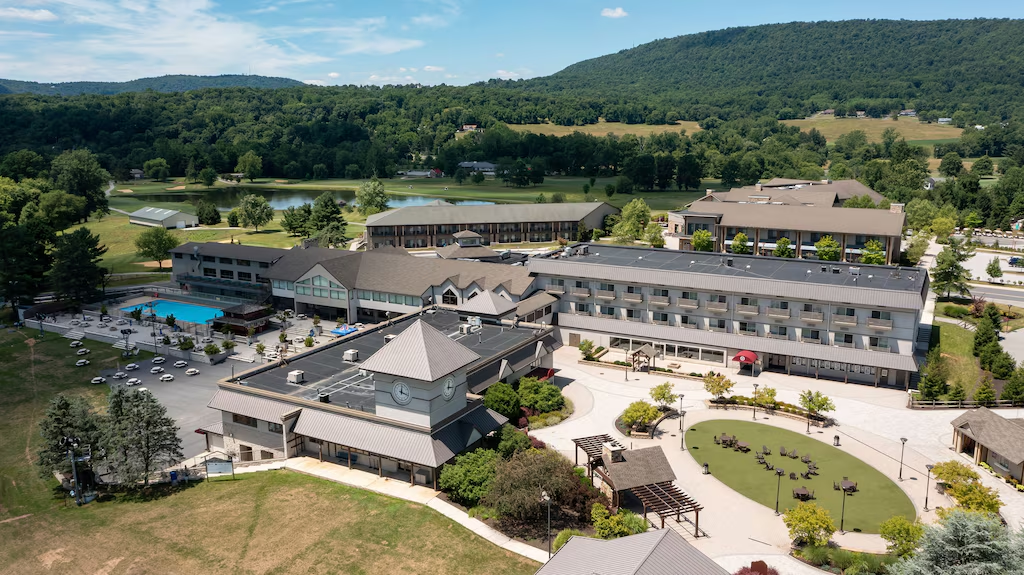
The search for the best lakefront hotels membership plans is often undermined by the assumption that all loyalty architectures function identically. In reality, these plans are highly heterogeneous, ranging from simple point-accrual systems to complex fractional-ownership or time-share-adjacent models that carry significant legal and financial burdens. A common misunderstanding involves the conflation of “exclusive access” with “guaranteed availability.” Many high-value memberships grant the right to request access, rather than the right to occupy, creating a hidden layer of friction that only becomes apparent during peak seasons. Furthermore, the reliance on digital, automated booking interfaces often masks the reality of site-specific inventory limitations, leading to a disconnect between the member’s expectations and the resort’s operational capacity.
The risk of oversimplification in this sector is acute. By treating a resort membership as a fungible commodity, prospective members ignore the site-specific constraints that govern the property. A membership at a lakefront property in the American Northeast, for instance, must account for seasonal dormancy, whereas a membership in a temperate, perennial-use environment carries a different set of maintenance requirements and cost structures. The best lakefront hotels membership plans are those that provide transparency regarding their operational limits, capital expenditure plans, and the specific, measurable benefits afforded to the member. Identifying these requires an audit of the resort’s governing documentation—an exercise that is far more revealing than any promotional brochure or marketing narrative.
Deep Contextual Background: The Evolution of Waterfront Hospitality Loyalty
The evolution of these membership plans mirrors the broader maturation of the American tourism industry. In the mid-twentieth century, private waterfront clubs and resorts functioned as closed, familial networks with informal, social-governance structures. Membership relied heavily on reputation and long-term patronage. As the industry consolidated, these informal systems proved inadequate to handle the scale and capital intensity of modern high-end hospitality. The pressure to generate consistent revenue, regardless of season or environmental conditions, drove the transition toward the contemporary, institutionalized membership model.
We have moved into the era of the “Hospitality-as-Infrastructure” model. Today, the most stable properties treat their members as stakeholders in a broader facility-management project. This evolution is not merely cosmetic; it represents a fundamental change in how resorts allocate risk. By inviting members into a formal, contractual arrangement, the resort distributes the cost of managing the shoreline interface—a process that requires constant investment in seawall stabilization, water-quality monitoring, and mechanical systems. Those who pursue the best lakefront hotels membership plans are essentially participating in the long-term stewardship of these sites, even if the marketing language obscures that reality behind a veneer of leisure and comfort.
Conceptual Frameworks and Mental Models
-
The Utility-Access Matrix: This model measures the efficiency of a membership plan based on the ratio of guaranteed access vs. the total cost of capital.
-
The Operational Redundancy Audit: This framework identifies whether the membership includes provisions for service continuity during site-wide mechanical or environmental failures.
-
The Asset Lifecycle Correlation: A mental model that links the cost of the membership to the planned capital expenditure cycle of the resort, ensuring the member is not funding the erosion of the property’s physical integrity.
-
The Friction Coefficient: A metric that quantifies the administrative effort required to actually utilize the benefits of the membership, highlighting the divide between promised and realized access.
Key Categories or Variations in Membership Structures
| Membership Category | Core Utility Profile | Primary Risk Factor |
| Institutional Loyalty Tier | Points-based; low barrier to entry | High dilution of elite benefits |
| Fractional Usage Rights | High-density seasonal access | Legal complexity; liquidity constraints |
| Private Equity Club | Ownership-based; governance role | High capital call; maintenance volatility |
| Corporate Access Bundle | Managed service for multiple users | Contractual rigidity; opaque pricing |
| Dynamic Membership Plan | Subscription-based; modular service | Inflation of base subscription costs |
Decision Logic: To evaluate the best lakefront hotels membership plans, one must assess whether the plan’s structure aligns with their specific frequency of use and tolerance for site-specific risk. A traveler seeking reliability should favor institutional tiers with hardened service-level agreements, while those seeking participation in the asset’s growth might consider more complex, equity-based models, provided they perform a rigorous audit of the resort’s long-term capital strategy.
Detailed Real-World Scenarios
-
The Peak-Season Capacity Squeeze: A member of a popular high-end resort finds that their “guaranteed” usage window is consistently overbooked by higher-tier members or private event rentals. This exposes a failure in the membership’s booking hierarchy and a breach of the implicit service contract.
-
The Ecological Intervention: An alpine resort, responding to rapid shoreline erosion, closes a significant portion of its lakefront amenities for an indefinite, year-long restoration period. Members who paid for the “full resort experience” find their utility slashed, revealing the absence of contingency planning in the base membership agreement.
-
The Management Transition: A property is sold to a private equity firm that aggressively cuts on-site staff to satisfy short-term quarterly targets. The decline in service quality becomes a systemic failure, where the membership benefits remain on paper but are functionally non-existent on-site.
Planning, Cost, and Resource Dynamics
Economic evaluation of these plans requires moving beyond the sticker price toward the “Total Cost of Ownership” for the duration of the agreement.
| Cost Variable | Impact on Total Value | Variability |
| Annual Maintenance Assessment | Critical | High |
| Base Membership Fee | Moderate | Low |
| Amenity-Access Surcharges | Moderate | High |
| Escrow/Capital Contribution | Extreme | Medium |
Note: The best lakefront hotels membership plans are characterized by price predictability; the most dangerous are those that reserve the right to levy unpredictable, uncapped assessments.
The Risk Landscape and Systemic Failure Modes
-
Mechanical Obsolescence: Waterfront sites require specialized, moisture-resistant HVAC and utility systems. A membership program that ignores the need for frequent upgrades to these hidden systems is a liability.
-
Regulatory Fragility: Waterfront properties are subject to a complex, overlapping web of local, state, and federal water-use regulations. A sudden policy change can render a membership’s primary value proposition—such as private dock access—illegal or severely limited.
-
Member Dilution: A membership model that relies on aggressive growth to fund its operations will eventually reach a point where the resort’s physical capacity is insufficient for the number of members, leading to a degradation of the entire experience.
Governance, Maintenance, and Long-Term Adaptation
-
The Governing Document Audit: Before joining, examine the bylaws governing the membership. Do they empower members to participate in the resort’s governance, or are they structured to keep the membership siloed from decision-making?
-
The Maintenance Review Cycle: Demand to see a ten-year capital expenditure plan. A resort that cannot articulate how it intends to maintain its shoreline and facilities over the next decade is not a responsible partner.
-
Layered Trigger Mechanisms: Establish clear thresholds for performance. If a resort’s water quality drops or amenity access falls below a predefined standard for more than one season, the member should have an automatic, contractual right to adjust their dues or exit the program without penalty.
Measurement, Tracking, and Evaluation
-
Leading Indicators: The responsiveness of the resort’s dedicated member-services team; the frequency and transparency of board reports regarding facility health.
-
Lagging Indicators: The rate of membership attrition; the visual and functional state of the property’s shoreline and exterior infrastructure.
-
Documentation: Maintain a personal ledger for each membership, tracking actual usage versus promised utility. This data is the only reliable metric for determining the true value of your investment.
Common Misconceptions and Oversimplifications
-
“Ownership equals control”: Even in equity-based clubs, management typically retains operational autonomy, limiting the member’s influence on daily site conditions.
-
“High demand equals high quality”: Popularity can actually lead to the degradation of the facilities, as the resort prioritizes volume over individual experience.
-
“Loyalty programs are passive”: The most effective members are active auditors who hold the resort accountable to its promises.
-
“Amenities are fixed assets”: In a waterfront environment, amenities are subject to constant decay and require active, ongoing investment.
-
“Digital booking is neutral”: Automation often prioritizes the resort’s yield management algorithms over the member’s experience or preference.
-
“Contracts are absolute”: Clauses regarding “unforeseen environmental events” are often broad enough to allow a resort to suspend almost any benefit at its own discretion.
Conclusion
The pursuit of the best lakefront hotels membership plans is, at its heart, an exercise in due diligence and long-term risk management. By stripping away the promotional language of exclusivity and leisure, the prospective member can see these arrangements for what they truly are: administrative interfaces with complex, vulnerable physical assets. The properties that stand the test of time—those that offer genuinely stable, high-performance utility—are the ones that approach their governance with transparency, prioritize the maintenance of their mechanical and shoreline infrastructure, and recognize that their members are partners in a long-term enterprise. True value in this sector is not found in the promise of easy access, but in the confidence that comes from participating in a well-managed, rigorously maintained, and structurally sound hospitality ecosystem