Best Secluded Lakefront Hotels United States: A Forensic Audit
The modern desire for “seclusion” in the hospitality sector often masks a fundamental misunderstanding of what such an environment entails. A truly secluded property is not merely a geographic coordinate far from urban noise; it is an engineered paradox. It exists as a highly controlled, high-performance node within a complex, often hostile, ecological system. When a traveler seeks out the best secluded lakefront hotels united states market, they are essentially looking for an institution that has mastered the art of “isolated infrastructure”—the ability to maintain seamless luxury-tier service in the absence of municipal support.
True seclusion imposes significant operational burdens. In an urban environment, utility failures, waste-management bottlenecks, or supply-chain interruptions are mitigated by the surrounding city grid. In a remote lakefront setting, these dependencies are entirely internal. The informed traveler must look past the aesthetic allure of the shoreline to evaluate the property’s “mechanical pedigree.”
This article serves as a diagnostic audit of this sector. We move away from the superficial criteria of “scenic views” and “privacy” to examine the underlying systems—the building envelopes, the logistical chains, and the long-term stewardship models—that determine the actual quality of a stay. By adopting this forensic approach, the prospective guest transitions from a passive consumer to an active participant in evaluating the resilience and operational maturity of their chosen destination.
Understanding best secluded lakefront hotels united states
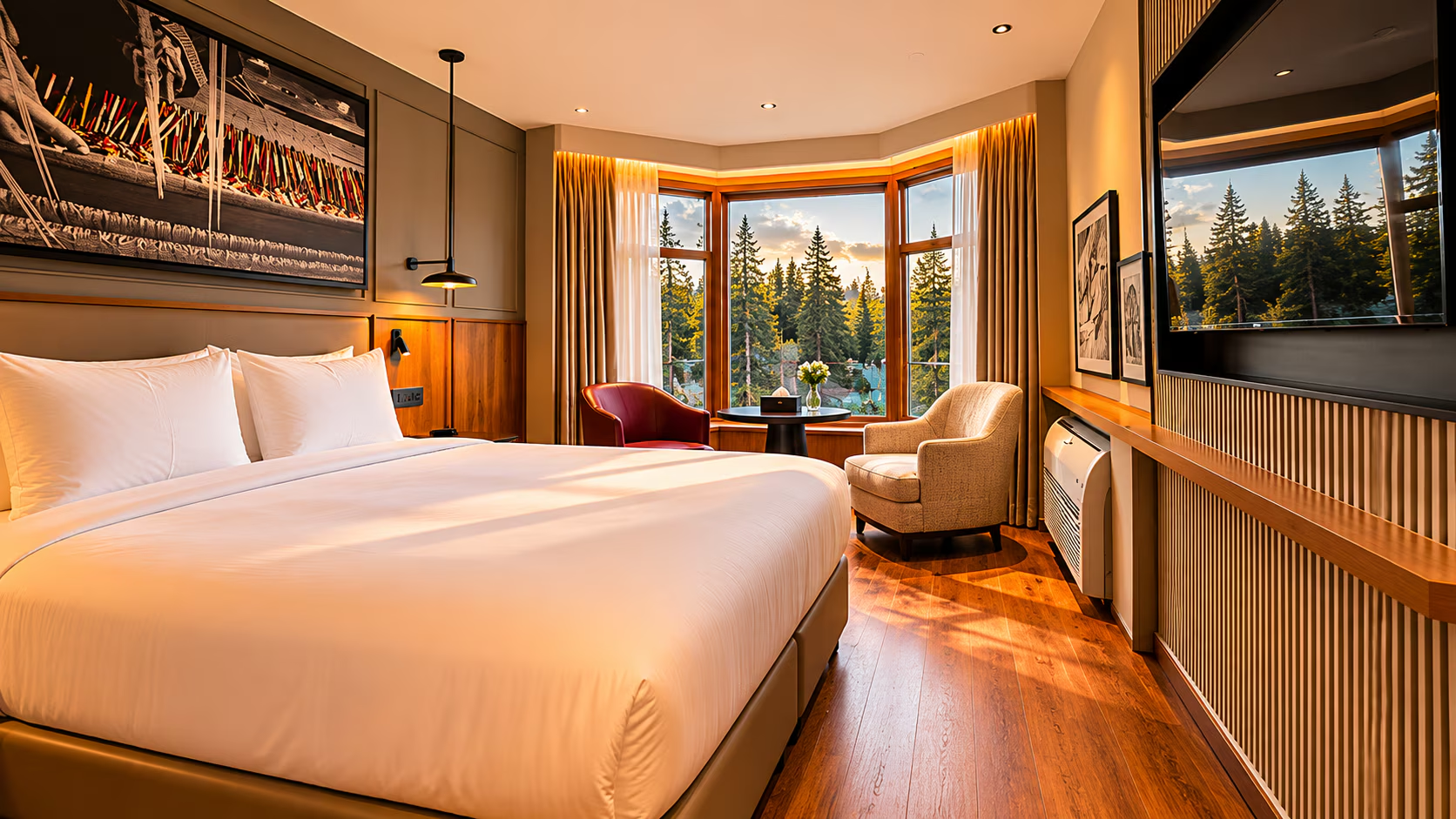
Identifying the best secluded lakefront hotels united states requires a recalibration of value. Most evaluations gravitate toward the visual—the aesthetic beauty of the cabin, the stillness of the water, or the “intimacy” of the dining room. This is a fragile basis for selection. The true measure of an elite secluded property is its “Operational Persistence Index.” Can the resort maintain a constant 70-degree interior climate and high-speed data connectivity during a regional power failure or a severe, multi-day storm event?
Common misunderstandings center on the belief that “secluded” implies a break from the modern world. In reality, successful seclusion is an act of extreme engineering. It is the ability to provide a seamless, modern experience in a location where the environment is actively trying to degrade the facility through moisture, temperature fluctuation, and biological growth. Oversimplification—such as assuming that all “lakeside lodges” offer equivalent levels of structural integrity—is the primary reason for guest dissatisfaction. We define the top tier not by their scenery, but by their ability to hide the gargantuan amount of work required to exist in their environment.
Deep Contextual Background: The Evolution of Isolated Stewardship
The history of lakefront hospitality in the United States reflects a trajectory from seasonal, low-impact summer camps to high-occupancy, year-round “institutional” retreats. Early iterations prioritized functional ventilation and light-frame construction, fundamentally unsuited for the intense, persistent moisture-loading of a lake basin. As demand for year-round luxury grew, developers pushed into increasingly fragile ecological zones, often ignoring the site-specific hydrological and geological constraints.
We are currently in a corrective, “Institutional Stewardship” phase. Modern, high-performance secluded resorts are defined by their integration of advanced drainage, climate-isolated building envelopes, and redundant utility systems. These properties have moved away from the “rustic facade” approach, acknowledging that the alpine or lacustrine climate is a continuous, aggressive force. The most successful properties are those that have stopped fighting the environment and have instead engineered their systems to harmonize with local ecological rhythms—such as utilizing passive cooling, geothermal heat exchange, and rigorously contained, zero-discharge waste management systems.
Conceptual Frameworks and Mental Models
-
The Envelope Integrity Audit: A mental model treating the hotel room as an air-gapped system; if the seal is compromised by moisture or poor insulation, the luxury experience is functionally void.
-
The Logistical Isolation Coefficient: A metric calculating the difficulty and cost of transporting essential supplies—from high-end food to specialized mechanical parts—to the resort. High coefficients correlate with higher risk of service degradation.
-
The Seasonal-Loading Model: A framework for evaluating how a property manages the massive disparity between peak-season traffic and off-season occupancy. The best properties use the off-season for “maintenance-deep” structural remediation, not just cost-cutting.
-
The Watershed Footprint Index: A model for determining if a resort’s waste management system is truly self-contained or if it is placing an invisible, cumulative burden on the lake’s sensitive ecosystem.
Key Categories and Operational Variations
| Category | Infrastructure Profile | Primary Strength |
| Tech-Hardened Enclave | Advanced climate-control; redundant power | Unmatched operational predictability |
| Heritage-Adaptive Lodge | Historical facade; modern high-efficiency retrofits | Atmospheric depth; deep aesthetic immersion |
| Eco-Minimalist Outpost | Site-integrated; zero-impact energy goals | Deep environmental reset; low-density |
| Institutional Lake-Hub | Large-scale, centralized utility grids | High-end service; standardized reliability |
Decision Logic: When selecting from the best secluded lakefront hotels united states list, prioritize “mechanical redundancy.” Does the resort have an on-site, automated-start generator system? Are the guest quarters climate-isolated from the exterior? If the answer is no, the property is a fragile asset.
Detailed Real-World Scenarios
-
The HVAC Synchronization Failure: In high-altitude or high-humidity lake environments, air density and vapor pressure are constant challenges. A resort that utilizes standard, low-altitude climate systems will encounter persistent failures, leading to mold and air-quality issues. The traveler who notices specialized humidity monitoring in the room description avoids this trap.
-
The Watershed Saturation Error: A resort expands its footprint, inadvertently altering the natural drainage patterns into the lake. Increased nutrient runoff causes localized algae blooms. This failure illustrates the “first-order” cost of ignoring site-specific geology when planning high-end, isolated amenities.
-
The Supply Chain Collapse: During a severe regional weather event, the primary access road is closed. A property that lacks an on-site, multi-week inventory of high-end consumables and emergency medical equipment suffers a total service breakdown, demonstrating the fragility of the “secluded” model.
Planning, Cost, and Resource Dynamics
The economic evaluation of these resorts requires a shift from standard “nightly rate” calculations to a “Total Cost of Resilience” assessment.
| Cost Variable | Impact on Value | Variability |
| Environmental Stewardship Systems | High | Extreme |
| Mechanical Redundancy (Generators/Backups) | High | High |
| Seasonal Operational Staffing | Moderate | Medium |
| Logistics/Supply Chain Maintenance | High | Extreme |
Note: The cost of true seclusion is often invisible, hidden in the price of maintaining a facility that must function as an island.
The Risk Landscape and Systemic Failure Modes
-
Compounding Moisture Ingress: In secluded, water-adjacent environments, the cycle of freezing and thawing creates exponential, non-linear degradation of building materials.
-
Management Myopia: Teams that focus exclusively on short-term quarterly revenue often defer critical, multi-year mechanical upgrades, leading to sudden, catastrophic failures during the peak season.
-
Governance Fragility: Many remote lakefront regions are governed by small, resource-strapped municipalities. A resort’s success is often tied to the local government’s ability to maintain roads and grids, which is entirely outside the resort’s direct control.
Governance, Maintenance, and Long-Term Adaptation
-
The Forensic Site Walk-Through: Upon arrival, examine the transitions where the building structure meets the mountain or lake foundation. Look for signs of moisture accumulation or structural shifting.
-
Operational Transparency Protocols: Prioritize resorts that actively communicate their maintenance protocols. A management team that discusses their humidity-control or waste-filtration systems is a team that understands its own environmental risks.
-
The Layered Checklist: Maintain a personal ledger for every stay, noting the correlation between the room’s mechanical performance and the property’s design age. This data reveals the properties that demonstrate high-performance stewardship.
Measurement, Tracking, and Evaluation
-
Leading Indicators: The precision of the resort’s pre-arrival communication; the presence of visible, modern facility-monitoring equipment in public or back-end areas.
-
Lagging Indicators: The variance in utility availability (e.g., hot water pressure, bandwidth uptime) during periods of high-occupancy peak load.
-
Documentation: Maintain a personal registry of site performance. This data provides the only feedback loop for distinguishing between “aesthetic luxury” and “operational resilience.”
Common Misconceptions and Oversimplifications
-
“Rustic equals relaxing”: Rustic often masks mechanical instability. Reliability is the only true form of relaxation in a professional or high-end context.
-
“High-end means tech-ready”: Luxury in décor and luxury in mechanical systems are two entirely different business models.
-
“The view is the amenity”: The view is a commodity; the true luxury is the facility’s ability to keep you comfortable while you observe it.
-
“Proximity to the water is a neutral feature”: It is a significant environmental liability; luxury is the mastery of that liability.
-
“Price is a proxy for safety”: Price often reflects marketing and location; it does not correlate with the frequency of structural or systems audits.
-
“Reviews capture the whole story”: Most reviews focus on the quality of the brunch and the softness of the pillows, not the mechanical reality of the building envelope.
Conclusion
Determining the best secluded lakefront hotels united states has to offer is a process of disciplined, forensic inquiry. By shifting focus from the visual landscape to the structural and mechanical integrity of the building, the traveler moves beyond the marketing veneer to identify properties that offer genuine stability. The secluded waterfront experience, at its most sophisticated, remains a triumph of engineering over nature—a comfortable, climate-controlled space carved into a volatile environment.