Lakefront Hotels Booking Plans: A Strategic Residency Guide
The selection of a lakeside accommodation often appears to be a matter of simple aesthetic preference. However, securing a professional-grade experience on the water demands a sophisticated approach to logistics, contract negotiation, and facility auditing. Inland water bodies present unique operational challenges that are frequently ignored by standard reservation platforms. Moisture control, mechanical stability, and site-specific access issues can fundamentally alter the quality of a stay. Therefore, the traveler must transition from a consumer mindset to one of strategic asset management.
A successful procurement process for a lakeside stay requires an understanding of the interplay between geography and hospitality. The lakefront is a dynamic environment, subject to seasonal fluctuations in water level, humidity, and accessibility. These factors exert pressure on the property’s infrastructure, and by extension, the guest experience. When a property fails to account for these variables, the resulting friction manifests as utility outages, air quality issues, or logistical bottlenecks.
This guide provides a rigorous framework for evaluating and securing these assets. We move past the glossy marketing material to examine the mechanical and operational realities that define high-performance waterfront hospitality. By establishing a definitive reference for development and booking, we offer a methodology that ensures long-term viability and operational consistency. For those who view their environment as a tool for recovery or output, this analysis serves as the baseline for all future planning.
Understanding lakefront hotels booking plans
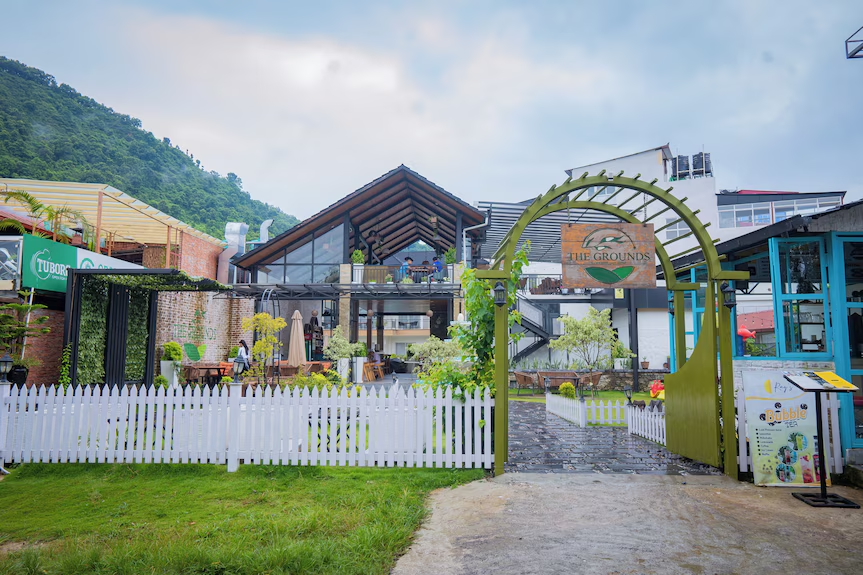
The term lakefront hotels booking plans is often misunderstood as a simple schedule of arrival and departure. In reality, it refers to the comprehensive strategy required to secure a facility that matches the technical requirements of the user. Most travelers overlook the operational dependencies of the property they book. They assume that proximity to water guarantees a high-performance environment. This is a common error. A property’s performance is defined by its ability to mitigate the environmental stressors of its location, not merely by the beauty of its view.
The risk of oversimplification is substantial. When one treats a complex waterfront asset as a generic commodity, they leave their experience vulnerable to systemic failures. A well-constructed booking plan accounts for the specific maintenance cycles of the property. It incorporates contingency for seasonal disruptions. It evaluates the hotel not by the photos on a website, but by the robustness of its infrastructure. Those who master these plans do not just book rooms; they procure environments that are resilient to the volatility of the natural world.
Deep Contextual Background: The Evolution of Waterfront Hospitality
The development of lakeside hospitality has moved through several distinct eras. Early projects favored rustic construction, emphasizing aesthetics over mechanical performance. These lodges were frequently plagued by dampness and poor climate control. The middle of the twentieth century saw a pivot toward high-density, mass-market developments. These structures favored volume, leading to the massive maintenance backlogs currently seen in many older waterfront assets.
Today, we operate in the “Adaptive Resilience” phase. Stakeholders realize that long-term value is tied to mechanical sustainability. Modern waterfront design utilizes advanced building envelopes and modular systems. These innovations combat the high-humidity environment that once destroyed traditional construction. This history is essential for anyone analyzing the market. The age of the asset and its subsequent mechanical retrofitting often serve as the most critical variables when comparing long-term stay options.
Conceptual Frameworks and Mental Models
-
The Shoreline Stressor Index: This model quantifies the impact of wind, moisture, and wave action on the facility’s structural integrity.
-
The Operational Redundancy Audit: This framework evaluates the property’s backup systems against the potential for regional utility failures in remote locations.
-
The Access-Friction Coefficient: This metric determines the difficulty of moving supplies, staff, and guests, which directly correlates to service consistency.
-
The Riparian Integration Score: This evaluates how the building footprint respects the shoreline, predicting the likelihood of future regulatory or structural instability.
Key Categories and Operational Variations
| Category | Typical Infrastructure Profile | Resident Trade-off |
| Institutional Eco-Resorts | Hardened mechanicals; integrated systems | Higher price; rigid service structures |
| Adaptive-Reuse Lodges | Heritage timber; rustic finish | High humidity risk; erratic utility stability |
| Purpose-Built Modernist | High-efficiency envelopes; minimalist | Lower square footage; architectural rigidity |
| Vertical Lakeside Towers | Centralized, dense mechanical systems | High strata fees; limited privacy |
Decision Logic: When auditing potential options, prioritize properties that provide transparent documentation of their facility management. If a hotel cannot articulate its moisture-mitigation strategy, it represents a high-risk asset for any extended-stay booking plan.
Detailed Real-World Scenarios
-
The Thermal Inversion Trap: A resort designed with expansive glass fails to account for night-time lake-effect cooling. This leads to massive heating expenses and fluctuating internal temperatures. The failure stems from flawed site-orientation planning.
-
The Septic Load Crisis: A property operating at maximum capacity during peak season exceeds its on-site waste-treatment limits. The resulting system failure forces an emergency facility closure. This illustrates the second-order effect of prioritizing volume over utility capacity.
-
The Network Isolation Cascade: During a regional storm, a hotel’s primary internet remains active. However, its internal mesh networking hardware fails because it lacks redundant power. Guests are trapped in a state of digital disconnection. This failure mode highlights the danger of relying on non-hardened infrastructure.
Planning, Cost, and Resource Dynamics
Economic success requires a move beyond base rates toward a “Total Cost of Presence” methodology. This accounts for the hidden expenses of operating in a sensitive, remote, or high-humidity environment.
| Cost Component | Relative Impact | Variability |
| Base Reservation Rate | 60% | Medium |
| Environmental/Utility Premium | 15% | High |
| Access/Logistics Surcharge | 15% | Variable |
| Risk/Maintenance Reserve | 10% | Low |
Note: Variability in lakefront pricing usually reflects the “Environmental Premium.” Properties located on complex or protected lakes incur higher logistical costs, which inevitably translate into higher rates or potential service degradation.
The Risk Landscape and Systemic Failure Modes
-
Shoreline Encroachment: Buildings set too close to the water face inevitable damage from cyclical lake levels and sediment erosion.
-
Vendor Lock-in: Remote resorts often depend on single-source local contractors for essential facility work. If these contractors are unavailable, the property’s functionality effectively halts.
-
Data Vulnerability: Because waterfront properties often attract high-profile guests, their reliance on custom networking setups creates security risks if the digital infrastructure is not professionally hardened.
Governance, Maintenance, and Long-Term Adaptation
-
The Inspection Cycle: High-performance operations conduct biennial shoreline stability assessments and annual HVAC moisture-load audits.
-
The Adjustment Trigger: Governance documents should explicitly define performance thresholds, such as a 5% drift in climate regulation, which automatically initiate a facility review.
-
Layered Maintenance Checklist: A rigorous, professional operation maintains a log that tracks everything from the structural health of the dock to the replacement cycles of the building’s vapor barriers.
Measurement, Tracking, and Evaluation
-
Leading Indicators: The responsiveness of the hotel to pre-stay questions about technical capabilities; the presence of modern exterior materials like non-corrosive alloys.
-
Lagging Indicators: The frequency of utility interruptions; the variance between advertised waterfront access and actual usable frontage; the rate of staff turnover in the maintenance department.
-
Documentation: Maintain a personal dossier on every major property utilized. Catalog the specific mechanical and operational experiences to build a proprietary database of reliable assets.
Common Misconceptions and Oversimplifications
-
“Lakefront equals pristine”: The water’s edge is a site of ecological complexity, including algae, insects, and humidity-related structural mold.
-
“Newer is always better”: Modern builds often rely on fragile, over-engineered systems that are difficult to fix in remote environments.
-
“The water view is the product”: The product is the environment from which the view is experienced. If that environment fails, the view becomes irrelevant.
-
“One size fits all”: The needs of a creative retreat differ fundamentally from those of a high-intensity corporate offsite.
-
“Luxury is visual”: True luxury in a lakeside setting is invisible—it is found in the reliability of climate control and network speed.
-
“Management is omnipotent”: Even the best teams face limits imposed by the physical realities of their location.
Conclusion
Mastering the process of securing high-performance waterfront accommodation separates the transient traveler from the strategic resident. By adopting a forensic view, one learns to see these properties for what they are: sophisticated, site-sensitive machines that require constant and careful oversight. Instead, it serves as a carefully curated space where the demands of modern life meet the stability of a professional environment.